

April 14, 2026
Shipping Container Roof Kits: Steel Arch, Gable, and PVC Compared by Span, Load Rating, and Install Time
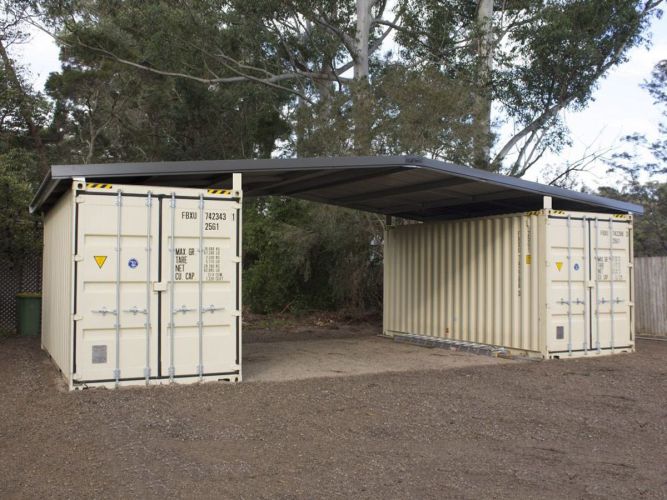
Two containers sitting 20 feet apart with nothing overhead is a liability. Rain soaks your materials, UV degrades your equipment, and that 400 to 800 square feet of usable space between the boxes sits empty. A shipping container roof system turns that dead zone into covered storage, a workshop, a loading area, or a vehicle bay without pouring a foundation or pulling a structural permit in most jurisdictions.
The containers themselves are the foundation. Each corner casting is rated to support 24 metric tons. You bolt a roof structure to the top edges of two parallel containers, and the span between them becomes a covered building. The result is a container cover building that goes up in one to three days with a crew of two to four people, at a fraction of what conventional steel construction costs.
But the kit you pick matters. Steel arch, gable steel, and PVC fabric canopy systems differ dramatically in lifespan, load rating, price, and portability. Below is a spec-driven breakdown so you can match the right shipping container roof kit to your site conditions and budget.
Important note: Mobile Modular Portable Storage does not rent, sell, install, or provide shipping container roof kits or roof systems. This guide is for informational purposes only to help customers understand common roof system options. We rent and sell the shipping containers that may be used as the base for a roof system project. Customers are responsible for sourcing, permitting, installing, and maintaining any roof kit or canopy system separately.
How Container Roof Systems Work
Every shipping container roof system starts with two containers placed parallel to each other, typically 20 feet apart. That 20-foot span is the standard because it matches container dimensions on the short axis. Pair two 20-foot containers and you get a 20x20 covered footprint (400 sqft). Pair two 40-foot containers and you get a 20x40 footprint (800 sqft).
Inside mount vs. outside mount is the first decision.
• Inside mount attaches to the interior top edges of each container. The span is narrower (roughly 18.5 feet clear width), but the hardware is cheaper and installation is faster. Good for basic weather protection where maximum width is not critical.
• Outside mount attaches to the exterior edges. You get the full 20-foot-plus span, and the container rooftops remain accessible for additional storage. Outside mount is the better choice if you plan to stage materials on top of the containers or need maximum clearance between them.
No foundation is required. The containers sit on compacted ground or gravel pads, and the roof structure bolts directly to the container edges. Center peak heights range from 10 to 15 feet depending on the kit profile, which gives enough clearance for forklifts, skid steers, and most box trucks.
Steel Arch Kits: The Most Common Permanent Option
Steel arch kits (Quonset-style) account for the majority of shipping container roof kit installations on jobsites, farms, and fleet yards. Manufacturers like Curvco, SteelMaster, and Archcore produce self-supporting arch panels in gauges from 22 (lightest) to 14 (heaviest).
Why arches dominate the market. The curved profile is self-supporting, meaning no interior columns or trusses eat into your usable space. Panels bolt together with a single nut-and-bolt size, which keeps the tool list short and the assembly learning curve flat. A crew of two can erect a 20x20 steel arch kit in one to two days.
Warranties on steel arch systems run 40 to 50 years, which puts them in the same lifespan bracket as a permanent metal building but at a lower installed cost. Panels are galvanized and can be ordered with baked-on color coatings to resist corrosion in coastal or high-humidity environments.
Where they fall short. Arch profiles shed snow well, but in heavy snow-load regions (above 40 psf ground snow load), you need 16-gauge or 14-gauge panels to prevent deflection. That heavier gauge pushes the price toward the top of the range. Arches also offer less headroom at the sidewalls compared to gable designs, which can matter if you are parking tall equipment near the edges.
Gable Steel Kits: Peak Performance in Snow Country
Gable-style steel container roof systems use a traditional peaked-roof design with straight sidewalls and a ridge beam. Manufacturers like Western Shelter and Shield Roof Solutions build these from American steel with 20-year warranties.
The peaked profile handles snow loads better than a shallow arch because snow slides off the steeper pitch instead of accumulating. Gable kits rated for 50-60 psf snow loads are standard catalog items. Straight sidewalls also give you full-height clearance all the way to the container edges, which is a real advantage for shipping container roof ideas involving vehicle storage or equipment bays where you need to park close to the walls.
The tradeoff is cost and complexity. Gable kits require more components (ridge beams, rafters, purlins, gussets) and take two to three days for a four-person crew to assemble. They are also harder to disassemble and relocate, making them a better fit for semi-permanent or permanent sites.
PVC Fabric Canopy Kits: Lowest Cost, Shortest Lifespan
A shipping container canopy with a galvanized steel frame and PVC fabric cover is the budget entry point. These kits run $1,500 to $6,000 and go up in half a day with two to three people.
Fabric canopies make sense for temporary or seasonal cover: harvest-season hay storage, a shaded staging area for a six-month construction project, or overflow vehicle parking. PVC fabric blocks UV and rain but degrades faster than steel. Expect a 5-to-10-year lifespan before the fabric needs replacement, and shorter in high-UV or high-wind environments.
Wind ratings on fabric shipping container canopy kits typically max out at 90 mph. If your site sees regular gusts above 70 mph, a steel system is the safer call.
| Configuration | Coverage (sqft) | Center Height | Typical Span |
|---|---|---|---|
| 20x20 (two 20ft containers) | 400 | 10–13 ft | 20 ft |
| 20x40 (two 40ft containers) | 800 | 10–15 ft | 20 ft |
| 20x60 (three 20ft containers end-to-end per side) | 1,200 | 10–15 ft | 20 ft |
Standard Sizes and Coverage
Most manufacturers sell standard 20-foot and 40-foot length kits. For longer runs, you add extension panels. If you need help selecting the right container length for your span, the container dimensions guide breaks down interior and exterior measurements for every standard size.
Container Roof Kit Cost Breakdown
| Kit Type | 20x20 Price Range | 20x40 Price Range | Warranty |
|---|---|---|---|
| PVC/fabric canopy | $4,000 | $6,000 | 5–10 years |
| Steel arch (Quonset) | $10,000 | $16,000 | 40–50 years |
| Gable steel | $13,000 | $30,000+ | 20 years |
Add $500 to $2,000 for freight depending on distance from the manufacturer. Container roof kit cost also varies by gauge: stepping from 22-gauge to 14-gauge steel can add 40-60% to the panel price, but it buys you significantly higher snow and wind load capacity.
For the containers themselves, storage container rental keeps your upfront capital lower on temporary projects. If the roof system is going to be permanent, buying the containers outright through containers for sale usually makes more financial sense over a 3+ year horizon.
Wind and Snow Load Ratings
| Factor | PVC Canopy | Steel Arch (22 ga) | Steel Arch (14 ga) | Gable Steel |
|---|---|---|---|---|
| Wind Load | 90 mph | 100–120 mph | 130–150 mph | 110–140 mph |
| Snow Load | 15–25 psf | 30–40 psf | 50–60 psf | 40–60 psf |
When to go heavier gauge. If your site is in ASCE 7 wind zones with basic wind speeds above 115 mph, or in regions with ground snow loads above 35 psf, specify 16-gauge or 14-gauge arch panels. The upfront cost increase is far cheaper than a collapsed roof and the equipment damage underneath it.
Anchoring matters too. In high-wind areas, through-bolt the roof mounting plates to the container corner castings rather than relying on sheet-metal screws into the container walls. Some installers weld the mounting plates for maximum hold.
Shipping Container Roof Kit Installation: Step by Step
Crew size: 2-4 people for steel kits, 2-3 for PVC canopy kits.
Tools: Socket wrench set (one size for arch kits), drill/impact driver, ladder or scaffolding, level, tape measure, safety harnesses for peak work.
Steel arch installation timeline (20x40, 3-person crew):
1. Position the two containers parallel, 20 feet apart, on level compacted ground. Verify spacing with diagonal measurements.
2. Bolt the mounting brackets (inside or outside mount) to the top edges of each container. Torque to manufacturer spec.
3. Assemble the first arch panel at ground level, then lift it into the mounting brackets. Two people lift while one fastens.
4. Continue adding arch panels, bolting each to the previous panel and to the mounting brackets. Work from one end to the other.
5. Install endwalls if included (partial endwalls with a drive-through opening are the most common for equipment access).
6. Add accessories: turbine vents, ridge vents, gutter systems, and lighting mounts.
Total time: 1 to 3 days, depending on kit size and crew experience. PVC canopy kits skip steps 3-5 and replace them with frame assembly and fabric tensioning, which cuts the timeline to 4-8 hours.
For custom shipping containers with pre-welded mounting plates or reinforced top rails, the installation is even faster because you skip the bracket-fitting step.
Applications by Industry
Construction. A steel container roof system between two containers on a jobsite creates instant covered storage for lumber, drywall, electrical panels, and anything else that cannot take rain. The containers themselves lock up tools and high-value materials at night. When the project wraps, the roof disassembles and ships to the next site. This is the single most common shipping container roof idea we see in the field: two 40-foot rentals with a steel arch kit overhead, creating 800 sqft of weather-protected staging area.
Agriculture. Farmers and ranchers use container cover buildings for hay storage, equipment shelter, and seasonal livestock cover. A 20x40 steel arch kit over two containers holds roughly 100 round bales out of the weather. The all-steel construction resists rodent damage better than pole barns with wood framing. In dairy operations, the covered area between containers serves as a milking prep area or feed storage bay.
Vehicle and fleet storage. Municipal fleets, rental companies, and private owners use shipping container canopy systems to cover trucks, equipment trailers, RVs, and boats. The 10-to-15-foot center height clears most recreational vehicles, and the open sides allow drive-through access.
Workshops and fabrication. Welders, mechanics, and fabricators set up shop in the covered span between containers, using the containers on each side as tool cribs and parts storage. Electrical and lighting run through conduit mounted to the arch panels.
Loading docks. A flat or shed-style roof extension from a single container creates a covered loading area for trucks. Common in distribution and logistics staging yards.
Rent Shipping Containers for Your Roof System Project
Mobile Modular Portable Storage rents and sells shipping containers that can be used as the foundation for a customer-supplied roof system. We do not rent, sell, install, or provide roof kits, canopy kits, steel arch systems, gable roof systems, or PVC fabric roof systems.
If your project requires shipping containers for covered storage, equipment staging, or a container-based shelter layout, our team can help you find the right container size and availability. Customers are responsible for selecting a third-party roof kit provider, confirming compatibility, securing permits, and arranging installation.
We offer 20-foot and 40-foot containers for rent or purchase from locations nationwide. Call 225-314-5776 or request a quote online to get container pricing for your project.
Frequently Asked Questions
Does Mobile Modular Portable Storage rent or provide shipping container roof kits?
No. Mobile Modular Portable Storage does not rent, sell, install, or provide shipping container roof kits, canopy kits, or roof systems. We only rent and sell the shipping containers that may be used as the base for a roof system. Customers must source the roof kit, installation, engineering, permitting, and maintenance through a third party.
Do I need a permit for a shipping container roof kit?
Can I mount a roof kit on containers that are different heights?
How far apart can the containers be for a roof kit?
Will the roof kit damage my rental containers?
What maintenance does a steel container roof system need?
Related Blogs