

April 16, 2026
How to Wire a Shipping Container: 60A-200A Panel Sizing and NEC Code Guide
You need lights, climate control, and power tools running inside a steel box that was never designed for any of it. Maybe you are converting a 20-foot container into a jobsite office. Maybe you are setting up a 40-foot container as a permanent workshop. Either way, the container itself does not come with a single outlet, switch, or circuit. Getting electricity into a shipping container means dealing with metal walls, grounding requirements specific to steel structures, and NEC codes that most residential electricians rarely encounter.
Here is the practical breakdown: power source options, panel sizing by actual load, code requirements that apply to metal enclosures, wiring methods that work on corrugated steel, and what it all costs.
Grid Connection, Generator, or Solar: Picking the Right Power Source
Grid-Tied Service (Most Common)
For any container that will sit in one location for more than a few months, a permanent grid connection is the most reliable and cost-effective option. The process involves running a feeder cable from an existing building’s sub-panel or pulling new service from the utility meter.
Underground feeder is the preferred method for permanent installations. NEC Article 300.5 requires a minimum burial depth of 24 inches for direct-buried UF cable, or 18 inches if you run conductors through rigid metal conduit. PVC conduit requires 18 inches of cover as well. Trench the cable from the main panel or meter base to the container, and terminate into a disconnect switch or sub-panel mounted on or inside the container.
Overhead feeder works when trenching is impractical. Aerial cables must maintain 10 feet of clearance over pedestrian areas and 12 feet over driveways, per NEC 225.18. Use a weatherhead at the container entry point and route conductors through rigid conduit down the exterior wall.
For temporary jobsite power on construction sites, a spider box or temporary power pole with GFCI-protected receptacles can feed the container through heavy-duty extension cords rated for the load. NEC Article 590 governs temporary wiring installations.
Generator Backup or Primary Power
Generators make sense for remote sites without grid access or as backup for critical operations. A 7,500-watt portable generator handles basic lighting, a few outlets, and a small AC unit. Larger standby generators in the 15-25 kW range can support full electrical loads including HVAC and equipment.
Position generators at least 5 feet from the container to prevent exhaust buildup. Connect through a transfer switch so the container can switch between grid and generator power without backfeeding. A manual transfer switch runs 800 installed; automatic transfer switches cost 2,500.
Solar (Off-Grid Niche)
Solar works for low-draw applications like LED lighting and device charging in remote locations. A 400-watt rooftop array with a 200Ah lithium battery bank and inverter can power LED lights and a few outlets in a storage container. But running HVAC or heavy equipment on solar alone requires a system costing 15,000+, which pushes most buyers toward grid or generator setups. Solar pairs better as a supplement to grid power, offsetting daytime loads while the grid handles peak demand.
Shipping Container Electrical Panel Sizing: 60A Through 200A
The panel you install dictates what the container can actually run. Undersizing means tripped breakers and overloaded circuits. Oversizing wastes money. Here is how to size correctly based on real-world container loads.
How to Calculate Your Load
Add up the wattage of everything you plan to run simultaneously. Divide total watts by voltage (120V for standard circuits, 240V for large equipment) to get amperage. Then add 25% safety margin per NEC 220.
Panel Sizing by Application
60-Amp Sub-Panel – Fits basic storage with lighting and a few outlets. Handles LED lighting, a small space heater, and 4-6 receptacles. Best for storage container rental setups that only need light and occasional power tool use.
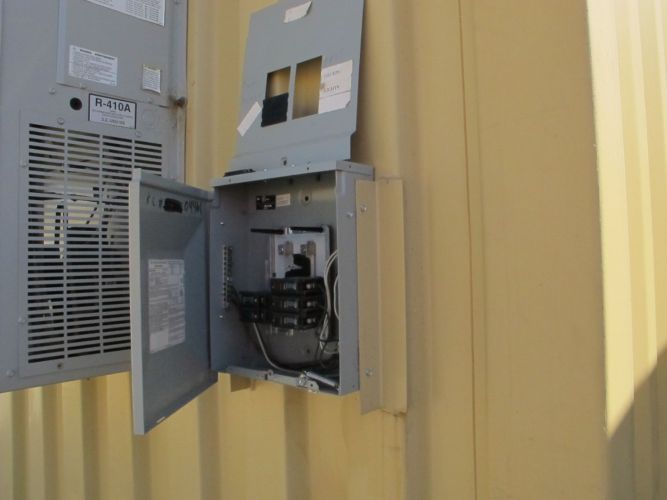
100-Amp Sub-Panel – The workhorse for most container offices and workshops. Supports a 12,000 BTU AC unit, full LED lighting, 8-10 receptacles, a small server rack, and phone/data equipment. NEC 230.79(D) requires a minimum 100A service for any container used as a dwelling unit.
125-Amp Panel – The spec on MMPS Elite office containers. Provides overhead for simultaneous HVAC, full lighting, multiple workstation circuits, and data equipment without running near capacity. More on that below.
200-Amp Panel – Required for containers housing welders, compressors, commercial kitchen equipment, or multiple HVAC units. Also appropriate for linked multi-container complexes sharing a single service.
Common Electrical Loads in Shipping Containers
| Equipment | Wattage | Amperage (120V) | Amperage (240V) |
|---|---|---|---|
| LED ceiling lights (full container) | 100–200W | 0.8–1.7A | — |
| 12,000 BTU mini-split AC | 1,200–1,500W | — | 5–6.3A |
| 5,000 BTU window AC | 500–600W | 4.2–5A | — |
| Electric space heater (1500W) | 1,500W | 12.5A | — |
| Standard duplex outlet (general use) | 180W avg | 1.5A | — |
| Desktop computer + monitor | 200–400W | 1.7–3.3A | — |
| Microwave (1000W) | 1,000–1,500W | 8.3–12.5A | — |
| Table saw | 1,800W | 15A | — |
| Welder (mid-range MIG) | 4,800–7,200W | — | 20–30A |
| Air compressor (5 HP) | 3,700W | — | 15.4A |
Add your simultaneous loads, apply the 25% NEC safety margin, and pick the panel that covers the total.
NEC Code Requirements for Shipping Container Electrical Systems
Steel shipping containers are not wood-framed houses. The NEC treats them differently, and inspectors will flag shortcuts that might pass in conventional construction.
Grounding: Non-Negotiable on Metal Structures
Per NEC 250.4, the metal container shell must be bonded to the electrical system ground. Drive an 8-foot copper-clad grounding rod into the earth near the container and connect it to the panel’s grounding bus with a #6 AWG or larger bare copper conductor. If the container sits on concrete or asphalt, you may need two grounding rods spaced at least 6 feet apart per NEC 250.53(A)(2) to achieve the required 25-ohm ground resistance.
Bond the container walls to the grounding system as well. Every metal surface that could become energized through a fault needs a path back to ground. Use grounding lugs bolted directly to the container frame and connected to the grounding bus.
GFCI Protection in Wet and Damp Locations
NEC 210.8 requires GFCI protection for receptacles in damp or wet locations. Shipping containers generate condensation, particularly in humid climates or during temperature swings. Treat all container receptacles as requiring GFCI protection unless the container is insulated with a vapor barrier and climate-controlled. Bathroom-type GFCI receptacles or GFCI breakers in the panel both satisfy the code.
Outdoor receptacles on the container exterior require both GFCI protection and weatherproof in-use covers rated for wet locations.
Working Space Clearances: NEC 110.26
The electrical panel needs specific clearance to pass inspection. NEC 110.26 requires a minimum of 36 inches of clear space in front of the panel, 30 inches wide, and headroom to the ceiling or at least 6.5 feet. In a standard container with 7’10“ interior height, headroom is not the issue. But in a packed container, maintaining that 36-inch clear zone in front of the panel takes deliberate planning. Mount the panel near the entry door where access stays unobstructed.
Conduit Requirements on Metal Structures
NEC 334.12(B) prohibits standard NM-B (Romex) cable on the exterior of metal buildings. On any exposed run along container walls, you must use conduit or approved raceway. Interior wall cavities with framing and insulation can use NM-B cable, but only if the cable is fully enclosed within the finished wall cavity and not in contact with the metal shell.
3 Wiring Methods That Work on Corrugated Steel Walls
EMT (Electrical Metallic Tubing) Conduit
The most common method for container electrical work. EMT conduit mounts to the corrugated walls using strut channel (Unistrut) or standoff clamps. It is durable, inspector-friendly, and allows future wire pulls without opening walls. Use 3/4-inch EMT for most branch circuits and 1-inch for feeder runs carrying #6 AWG or larger conductors. Cost runs 4 per linear foot for materials.
The downside: EMT follows the corrugation profile, adding labor time for bends and offsets. Plan conduit runs along the flat ribs of the corrugation where possible.
Surface-Mount Raceway (Wiremold)
Plastic or metal raceway channels mount flat against the wall and hold wiring inside a snap-on cover. Raceway works well in finished container interiors where aesthetics matter, like retail spaces or client-facing offices. It installs faster than EMT but holds fewer conductors per channel.
Raceway does not satisfy NEC requirements for exterior runs on metal structures. Use it only inside containers with finished interior walls.
Insulated Wall Cavities with NM-B Cable
If you are framing out the container interior with steel studs or wood furring strips and adding insulation, you can run standard NM-B (Romex) cable through the wall cavity just like in conventional construction. The key requirement: the cable cannot contact the metal container shell. Maintain at least 1.25 inches of separation or use nail plates where cable passes through studs near the metal wall.
This method gives the cleanest finished look and works for custom shipping containers built out as permanent offices, retail spaces, or living quarters. Check your local jurisdiction, as some areas require conduit regardless of wall cavity installation.
The Pre-Wired Shortcut: MMPS Elite Office Container Specs
Wiring a container from scratch takes 2-5 days of electrician labor plus permitting time. If you need a powered workspace fast, MMPS Elite office containers ship with the electrical system already installed and inspected.
The standard Elite electrical package includes:
• 125-Amp electrical panel with breaker protection
• LED ceiling light strips across the full interior
• 12,000 BTU air conditioning (240V mini-split)
• GFCI-protected duplex receptacles on dedicated circuits
• Phone and data access points with CAT5 wiring
• Exterior weatherproof receptacle for outside power needs
All wiring runs through conduit per NEC standards. The panel is pre-loaded with labeled circuits and has spare breaker slots for adding circuits on site. You connect the feeder cable from your site’s power source to the container’s main disconnect, and the interior is ready to go.
Available in 20-foot and 40-foot configurations, Elite containers work for construction offices, remote project management, equipment monitoring stations, and any application where downtime costs more than the rental. Review container dimensions to confirm the footprint fits your site, then request a quote for pricing and availability. MMPS responds within 1 hour and delivers from 30+ locations across 27+ states.
Shipping Container Electrical Cost Breakdown
What you spend depends on the scope. Here is what each tier actually looks like.
| Project Scope | What Is Included | Estimated Cost ($) |
|---|---|---|
| Basic storage lighting | 60A sub-panel, 2–4 LED fixtures, 2–4 outlets, single circuit, basic grounding | 1,500–3,000 |
| Standard office/workshop | 100A sub-panel, full LED lighting, 6–8 GFCI outlets, dedicated HVAC circuit, data wiring, grounding rods | 3,000–6,000 |
| Full office buildout | 125A+ panel, insulated walls, multiple circuits, HVAC, full lighting, phone/data, permit fees | 6,000–10,000 |
| Commercial/industrial | 200A panel, heavy equipment circuits, 240V service, multiple HVAC zones, fire alarm tie-in, commercial inspection | 10,000–15,000+ |
| Pre-wired Elite container (rental) | 125A panel, LED lighting, 12K BTU AC, GFCI receptacles, phone/data – all installed | Included in rental rate |
Labor accounts for 50-65% of the total cost in most container electrical projects. Permit fees vary by jurisdiction but typically run 300 for residential-class work and 750 for commercial. Getting a pre-wired container through storage container rental eliminates the electrical buildout cost entirely.
For containers you own outright, the electrical investment adds long-term value. Browse containers for sale and factor in the wiring cost as part of your total project budget.
Skip the buildout timeline. MMPS Elite office containers arrive with a 125-Amp panel, LED lighting, 12K BTU AC, and GFCI outlets already wired and inspected. Connect your site power, and you are operational the same day. With 30-day billing cycles and quote responses within 1 hour, the math favors renting pre-wired over building from scratch. Call 225-398-8176 or request a quote to get specs and availability for your site.
Frequently Asked Questions
How much does it cost to run electricity to a shipping container?
Grid connection costs depend on distance from the power source. Running a 100A underground feeder 50 feet from an existing panel typically costs 1,500 for the trench, conduit, wire, and disconnect. The interior wiring itself adds 6,000 depending on scope. Total project costs range from $1,500 for basic lighting to $15,000+ for commercial-grade buildouts.
What size electrical panel do I need for a shipping container?
Can I use Romex (NM-B) cable in a shipping container?
Does a shipping container need to be grounded for electrical work?
Should I wire a shipping container myself or hire an electrician?
Related Blogs