

April 16, 2026
Shipping Container Weight: Tare, Payload, and Road Limits for 20ft and 40ft Units
An overweight container at a DOT checkpoint can cost you $1,000 to $10,000 in fines, depending on the state and how far over the limit you are. Beyond fines, carriers can refuse to move a container that exceeds road weight limits, leaving your cargo stranded. Crane operators check lift capacity against container gross weight before every pick; get the number wrong, and the crane doesn’t move. For ocean export, a container without a Verified Gross Mass (VGM) declaration doesn’t get loaded onto the vessel.
Shipping container weight drives transport planning, site prep, equipment selection, and regulatory compliance on every job. Below are the exact numbers, the federal and state rules that govern them, and the practical calculations that keep your loads legal.
Shipping Container Weight by Size: 10ft, 20ft, 40ft, and 40ft High Cube
Every shipping container has three weight figures that matter:
• Tare weight: the weight of the empty container itself, stamped on the CSC plate
• Maximum gross weight: the absolute maximum the container is rated to carry, including tare weight, set by ISO standards
• Payload capacity: the difference between max gross weight and tare weight; the actual cargo you can load
Here are the standard specifications. Actual tare weights vary slightly by manufacturer and age of the unit.
| Container Size | Tare Weight | Max Gross Weight | Payload Capacity |
|---|---|---|---|
| 10ft Standard | ~2,645 lbs (1,200 kg) | ~22,400 lbs (10,160 kg) | ~19,755 lbs (8,960 kg) |
| 20ft Standard | ~5,070 lbs (2,300 kg) | 67,200 lbs (30,480 kg) | ~62,130 lbs (28,180 kg) |
| 40ft Standard | ~8,265 lbs (3,750 kg) | 67,200 lbs (30,480 kg) | ~58,935 lbs (26,730 kg) |
| 40ft High Cube | ~8,750 lbs (3,970 kg) | 67,200 lbs (30,480 kg) | ~58,450 lbs (26,510 kg) |
The 20ft and 40ft containers share the same 67,200-lb max gross weight rating, which means a 20-foot container has a higher payload-to-size ratio than a 40-foot container. Dense, heavy cargo like machinery and steel coils often ships in 20ft units, while lighter, bulkier cargo goes in 40ft containers where volume is the constraint. For full interior and exterior measurements, see our guide to container dimensions.
Keep in mind: the max gross weight stamped on the container is a structural rating for the floor, walls, and corner castings. It does not tell you what the road can handle. Road limits are almost always lower, and that distinction catches people off guard.
The CSC Plate: Where to Find Your Container’s Exact Weight Rating
Every ISO shipping container carries a CSC (Convention for Safe Containers) plate riveted to the left door. The plate lists the data points you need before loading or transporting the unit:
• Maximum gross weight (listed in kg and lbs)
• Tare weight (the empty container weight, in kg and lbs)
• Allowable stacking weight (how much weight can be placed on top during stacking)
• Racking test load value (the transverse force the container is rated for)
• Date of manufacture and inspection history
Before accepting delivery on any storage container rental or purchasing containers for sale, check the CSC plate. A container with a missing or illegible CSC plate cannot legally be used for ocean transport, and many inland carriers will also refuse it. The tare weight stamped on the plate is the starting point for every payload calculation you’ll make.
If the plate shows a tare weight that seems unusually high or low compared to the table above, the container may have been modified. Insulation, interior paneling, electrical systems, and other buildouts add weight that the original CSC plate does not reflect. More on that below.
Road Transport Weight Limits: 80,000-lb GVW and the Axle Rules That Actually Get You Cited
A 20ft shipping container rated for 62,130 lbs of payload will never carry that much on a U.S. highway. The truck, chassis, and container combined must stay under the federal gross vehicle weight (GVW) limit of 80,000 lbs.
Here is how the math works in practice:
Federal GVW Breakdown for a Loaded Container on a Truck
| Component | Typical Weight |
|---|---|
| Tractor (semi-truck) | 17,000–20,000 lbs |
| Container chassis | 7,000–10,000 lbs |
| Container tare weight (20ft) | ~5,070 lbs |
| Remaining for cargo | ~42,500–50,000 lbs |
For a 20ft container, the practical road payload before hitting “heavy haul” classification in most states lands around 37,500 lbs. For a 40ft, it’s roughly 43,500 lbs. Go above those thresholds and you’ll need overweight permits, route restrictions, or both.
Axle Limits and the Bridge Formula
Federal law also caps weight per axle group:
• Single axle: 20,000 lbs
• Tandem axle (two axles spaced 4–5 ft apart): 34,000 lbs
The Federal Bridge Formula calculates allowable weight based on the number of axles and the distance between the first and last axle. A 5-axle tractor-trailer with a 51-foot outer axle spread maxes out at 80,000 lbs GVW. Shorten the spread, and the allowable weight drops.
More than 50% of overweight violations at DOT checkpoints are axle-related, not total GVW violations. A container loaded with 35,000 lbs of cargo concentrated at one end can pass a total GVW check but fail an axle weigh. Distribute cargo evenly from front to back and keep the center of gravity low.
Overweight Permits
Many states issue overweight permits that allow 10,000 to 15,000 lbs above the standard 80,000-lb GVW, bringing the permitted maximum to roughly 90,000 lbs. Requirements vary by state: some mandate specific routes, escort vehicles, or travel-time restrictions. Your carrier handles the permit application in most cases, but you need to know your loaded container weight before requesting one.
VGM (Verified Gross Mass) for Ocean Export: SOLAS Requirements Since 2016
If you are shipping a container overseas, the International Maritime Organization’s SOLAS (Safety of Life at Sea) regulations require a Verified Gross Mass declaration before the container can be loaded onto a vessel. The VGM rule has applied to every packed container moving by ocean freight worldwide since July 1, 2016.
Two methods are accepted:
Method 1: Weigh the fully packed and sealed container on a certified scale (weighbridge or crane scale). The resulting figure is the VGM.
Method 2: Weigh all cargo items, dunnage, bracing, and packing materials individually, then add those weights to the container’s tare weight from the CSC plate.
The shipper named on the bill of lading is responsible for providing the VGM to the carrier and port terminal. A container without a VGM declaration will not be loaded. No exceptions. If you are exporting via ocean freight from any U.S. port, build VGM weighing into your packing process.
Three Methods for Weighing a Loaded Container
Weighbridge (truck scale): A platform scale embedded in a concrete foundation. The truck drives on fully loaded, records the gross weight, then again empty for net cargo weight. Accuracy is within 0.2%–0.5%, making it the standard for VGM Method 1 certification.
Axle weigh pads: Portable scales placed under each axle group. Less accurate (1%–2% tolerance), but fast, mobile, and able to identify uneven distribution between axle groups. Useful for field checks before DOT checkpoints.
Crane scale (dynamometer): A load cell suspended between the crane hook and the container’s lifting hardware. Reads weight during the lift. Common at ports and construction sites. Accuracy is typically within 0.5%–1%.
Site Delivery Weight Considerations: Ground Pressure, Equipment Capacity, and Truck Access
Knowing how much a shipping container weighs matters well before cargo is loaded. A fully loaded 40ft container at 67,200 lbs gross weight creates serious ground bearing pressure, and your site needs to handle it.
Ground bearing pressure: A 40ft container’s footprint is approximately 320 sq ft, producing about 210 lbs per sq ft at max gross weight. Load concentrates at the four corner castings during crane placement. Gravel pads, concrete footings, or railroad ties under the corners distribute the load for soft-ground installations.
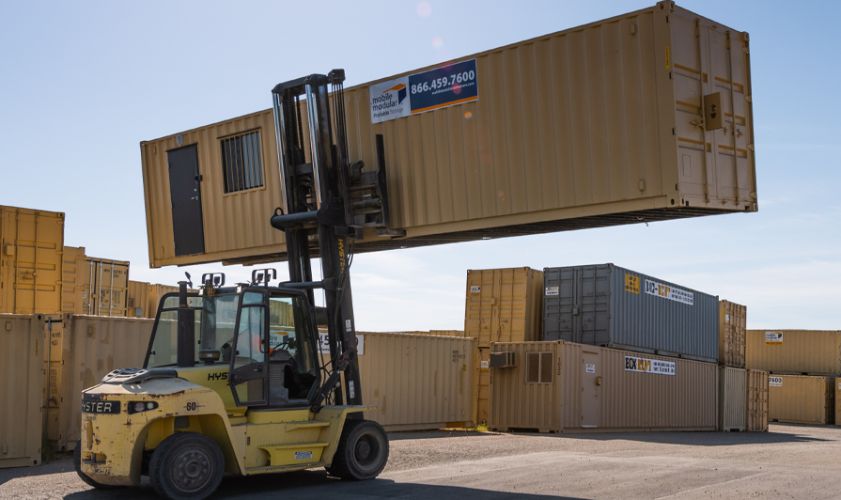
Equipment requirements: A tilt-bed truck can deliver and place containers up to roughly 16,000 lbs. For loaded containers or heavier modified units, a crane with sufficient lift capacity is required. Make sure your site has overhead clearance and swing radius for the crane boom. Mobile Modular Portable Storage uses expert delivery drivers with A+ driving records who assess site conditions before placement.
Access route: The delivery truck needs at least 12 ft of width and 60 ft of straight-line approach for a 40ft container drop. Tight sites, soft shoulders, or overhead power lines change the delivery method and may add cost.
How Modifications Change Shipping Container Weight
A standard shipping container’s tare weight assumes bare steel: corrugated walls, plywood floor, and steel doors. Modifications add weight that must be factored into payload calculations and transport planning. Here is what common buildouts typically add:
• Insulation (spray foam or rigid panel): 500–1,000 lbs depending on container size and insulation thickness
• Interior framing and wall paneling: 300–700 lbs
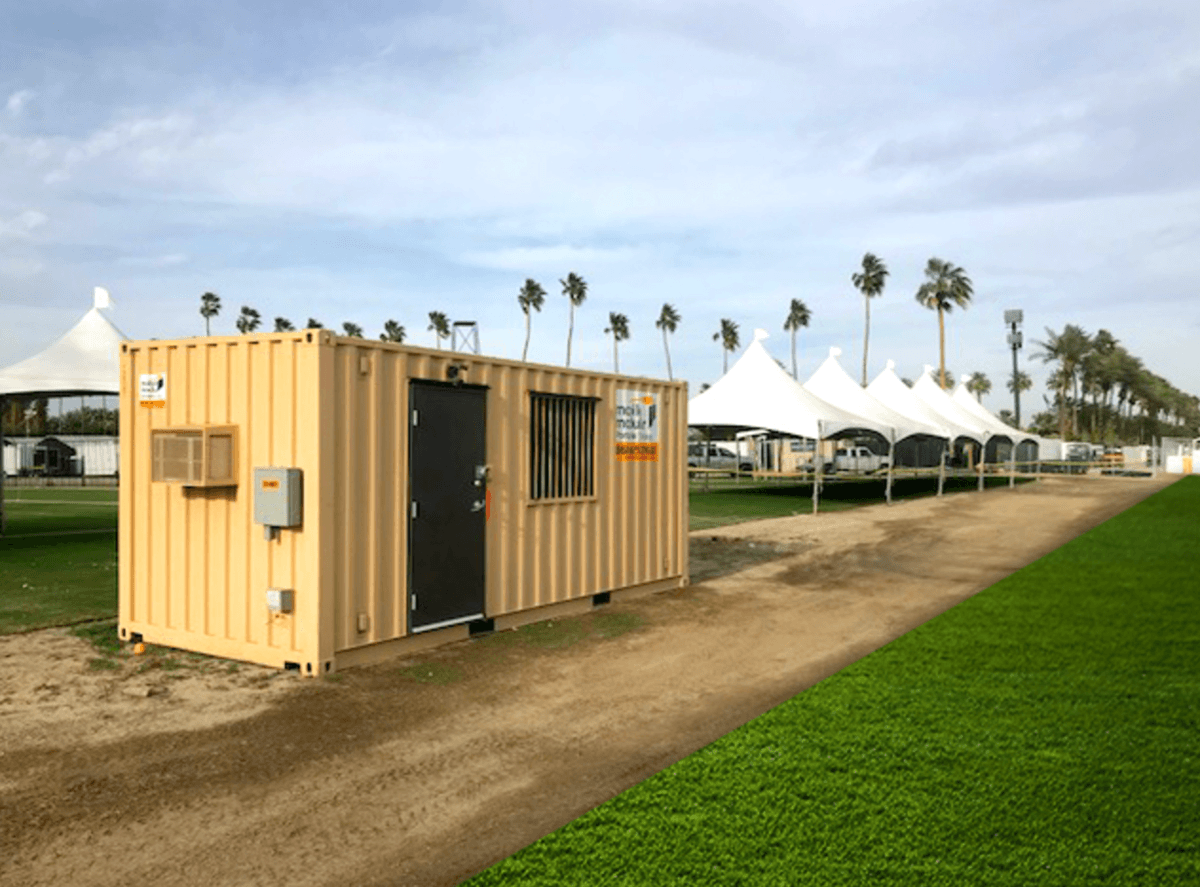
• Office buildout (insulation + framing + electrical + HVAC + flooring): 1,500–3,000 lbs for a 20ft unit; 2,500–5,000 lbs for a 40ft unit
• Roll-up door or additional man doors: 200–400 lbs per door
• Windows: 50–100 lbs per window opening with frame
A 20ft container converted into a job-site office with full insulation, electrical, HVAC, and interior finish can weigh 7,000–8,000 lbs empty versus the standard 5,070 lbs. That extra weight reduces your available payload and changes delivery equipment requirements. If you are planning a custom shipping container project, get the projected modified weight from your provider before finalizing transport logistics.
Payload Calculation: A Step-by-Step Field Method
Use this process every time you load a container for transport:
1. Read the CSC plate. Record the tare weight and max gross weight.
2. Add modification weight. If the container has been modified, add the weight of all buildout materials to the tare weight to get your true empty weight.
3. Subtract from road limit, not container limit. Your effective payload is the lower of (a) max gross weight minus true empty weight, or (b) 80,000 lbs GVW minus truck weight minus chassis weight minus true empty weight.
4. Check axle distribution. Load cargo evenly and verify axle weights with pads or at a truck scale before departing.
5. Document the VGM. If the container is moving to a port for ocean export, record and submit the Verified Gross Mass to the carrier.
For most domestic road transport jobs, step 3 is the bottleneck. The container’s structural rating allows far more weight than the road does.
Get Exact Weights for Your Container Size and Configuration
Mobile Modular Portable Storage stocks 10ft, 20ft, 24ft, and 40ft containers at 30+ locations across 27+ states. Every unit ships with a legible CSC plate and verified tare weight. Our 30-day billing cycles save you 8.3% compared to providers billing on 28-day cycles, and we respond to quote requests within 1 hour.
Call 225-398-8176 or request a quote with your container size, cargo weight, and delivery address. We will confirm the right unit, verify transport weight compliance, and schedule delivery with a driver who knows your route.
Frequently Asked Questions
How much does a 20ft shipping container weigh empty?
A standard 20ft shipping container has a tare weight of approximately 5,070 lbs (2,300 kg). The exact weight varies by manufacturer and condition. Modified containers with insulation or interior buildouts weigh more. Always check the CSC plate on the container door for the stamped tare weight.
What is the maximum weight you can put in a 40ft container?
Do I need an overweight permit to move a fully loaded shipping container?
What is the difference between tare weight and gross weight?
Can the ground support a full shipping container?
Related Blogs