

April 16, 2026
Open-Side Shipping Containers: Full-Side Forklift Access, Specs, and Pricing
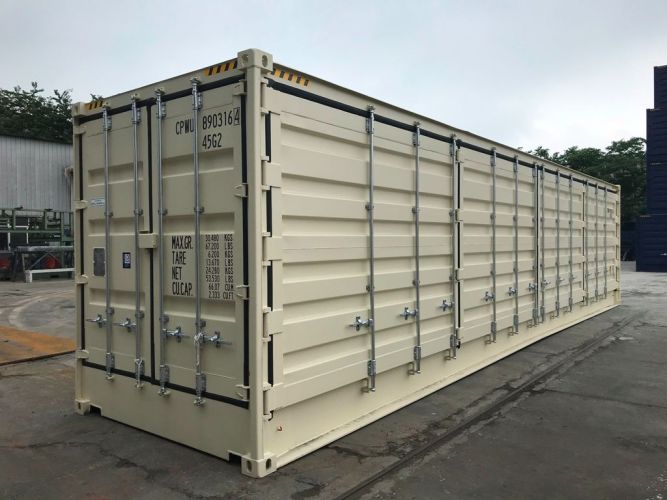
Picture a standard 40-foot shipping container. The only way in is through the 7-foot 8-inch wide end doors. Your forklift operator needs to reach cargo staged 39 feet deep, but the machine can’t turn inside an 8-foot-wide box. Pallets get double-handled. Twenty-foot lumber doesn’t clear the opening at an angle. Pipe bundles need to be staged in reverse order so the last load in goes out first.
Open-side shipping containers fix all of that. Bi-fold doors span the entire long wall, giving a forklift full-side entry at any point along the container’s length. The result: faster loading cycles, fewer damaged goods, and direct access to every pallet without shuffling cargo.
How Bi-Fold Side Doors Work on Open-Side Containers
An open-side container replaces one full-length wall with two or more bi-fold door panels. These panels fold back 180 to 270 degrees depending on the manufacturer’s design, laying flat against the container’s exterior so they don’t block forklift lanes or staging areas. The standard end doors remain in place at one short wall, so you still have the option of end-loading when that’s more practical.
The engineering is more involved than most buyers realize. A standard container’s corrugated side walls are structural, contributing to the box’s racking strength (the ability to resist twisting forces during lifting and transport). Removing an entire wall and replacing it with hinged door panels means the frame needs heavier corner posts, reinforced top and bottom rails, and additional cross-members to maintain rigidity. That reinforcement is the primary reason open-side containers cost significantly more than standard units.
The door panels themselves are built from corrugated Corten steel, the same material as standard container walls. Rubber gaskets line every seam, and locking bars secure the panels at multiple points along the top and floor rails. When closed and locked, the container is wind- and weather-tight.
20ft and 40ft Open-Side Container Dimensions and Weight Specs
Open-side containers are available in 20-foot and 40-foot lengths, each in standard height (8’6“) and high-cube (9’6“) configurations. For a full breakdown of standard container sizing, see our guide to container dimensions. The table below covers the open-side-specific measurements.
| Specification | 20ft Standard | 20ft High Cube | 40ft Standard | 40ft High Cube |
|---|---|---|---|---|
| Exterior (L x W x H) | 20’ x 8’ x 8’6” | 20’ x 8’ x 9’6” | 40’ x 8’ x 8’6” | 40’ x 8’ x 9’6” |
| Interior (L x W x H) | 19’ x 7’8” x 7’10” | 19’4” x 7’6” x 8’6” | 39’5” x 7’5” x 7’6” | 39’5” x 7’6” x 8’1” |
| Side Door Opening | ~19’ x 7’5” | ~19’ x 8’2” | ~39’ x 7’6” | ~39’ x 7’10” |
| End Door Opening | 7’8” x 7’5” | 8’2” x 7’4” | 7’8” x 7’6” | 7’3” x 7’10” |
| Tare Weight | ~5,070 lbs | ~7,385 lbs | ~13,448 lbs | ~14,510 lbs |
| Max Payload | ~47,900 lbs | ~45,000 lbs | ~58,600 lbs | ~57,500 lbs |
| Floor Type | Marine-grade plywood | Marine-grade plywood | Marine-grade plywood | Marine-grade plywood |
| Forklift Pockets | Yes | Yes | Yes | Yes |
Payload ratings vary by manufacturer and ISO certification. Always confirm the rated payload on the CSC plate before loading.
How Full-Side Forklift Access Changes the Loading Workflow
This is the reason open-side containers exist, and it’s worth explaining in detail, because the operational difference between end-loading and side-loading is dramatic.
End-Loading Limitations
With a standard container, your forklift enters through the 7’8“-wide end door. Inside, the container is roughly 7’5“ to 7’8“ wide. A standard forklift with a 48-inch pallet on the forks barely fits, and turning inside is not possible. The operator drives straight in, sets the pallet, and backs straight out. To place a pallet at the far end of a 40-foot container, the forklift travels nearly 40 feet in and 40 feet back out for every single pallet. Multiply that by 20 to 24 pallets and you’re looking at serious cycle time.
Items longer than about 7 feet can’t enter through the end door at an angle. Lumber, pipe, conduit, and scaffolding sections all become loading headaches that force crews into slower manual handling.
Side-Loading Advantages
Open the bi-fold doors and the entire long wall becomes a loading bay. A forklift approaches perpendicular to the container, drives straight in from the side, sets a pallet, and backs out in seconds. There’s no 40-foot tunnel to traverse. Every pallet position is directly accessible from the side opening.
For oversized items, the advantage is even clearer. A 20-foot bundle of 2x4 lumber slides straight in through the side of a 20-foot container with no angling required. Pipe bundles drop right into place. Heavy equipment components that would need a crane to maneuver through end doors can be forked in from the side in one motion.
Forklift Requirements for Container Work
Your forklift needs a minimum 10,000-pound lift rating to handle standard palletized loads inside a container, and the mast height must clear the interior ceiling. Pneumatic-tire forklifts work best on the marine-grade plywood floor that comes standard in open-side containers. Make sure the forklift pockets on the container’s base are compatible with your transport equipment if you plan to relocate the unit loaded.
The plywood floor is typically 28mm marine-grade apitong or equivalent hardwood, rated for point loads from forklift wheels. Avoid spinning tires on the surface, as it will gouge the flooring over time.
Industry Applications: Construction, Retail, and Warehousing
Construction Sites: Staging and Tool Access
Construction is the highest-demand sector for open-side containers. Job sites generate a constant flow of materials that need to be stored, accessed, and rotated. With a standard container, pulling a specific item from the back means unloading everything in front of it.
An open-side container on a construction site functions more like a covered, lockable staging area. Framing lumber goes in one section, mechanical supplies in another, and finish materials in a third. The crew opens only the door panels they need. During peak activity, all panels fold back to create a sheltered work area with a roof overhead.
General contractors running multi-phase projects find side access particularly valuable during material transitions. When the framing package arrives while foundation materials are still being consumed, both can occupy the same container. Each crew accesses their materials from a different section of the side opening. For job sites needing standard storage container rental alongside open-side units, MMPS can deliver both on coordinated schedules.
Retail Pop-Ups and Event Installations
Retail operators converting containers into pop-up shops or event bars benefit from the full-wall opening. One side folds open to become the customer-facing storefront, with serving counters, display shelving, and signage mounted to the interior walls. When the event ends, the doors close and the entire shop is locked and weather-sealed in minutes.
Warehousing and Distribution
Warehouses at capacity sometimes deploy open-side containers as overflow storage in parking areas or loading docks. Forklift operators treat the side-opening container like a rack bay: drive up, fork in, drive out. For seasonal inventory surges, renting open-side units through an open-sided container rental program avoids the cost of permanent building expansion.
Open-Side Container Pricing: Purchase and Rental Costs
Open-side containers carry a significant price premium over standard units. The specialized door engineering, heavier frame construction, and lower production volume all drive costs up.
| Container Type | Purchase Price Range ($) | Notes |
|---|---|---|
| 20ft standard container | 2,000–3,500 | End doors only |
| 20ft open-side container | 6,500–9,500 | Bi-fold side doors + end doors |
| 40ft standard container | 3,000–5,500 | End doors only |
| 40ft open-side container | 9,500–15,000+ | Bi-fold side doors + end doors |
That’s roughly 2x the cost of a standard container in the same size. Pricing depends on new vs. used condition, supplier location, and any modifications. Used open-side containers are scarce because production volumes are low and owners tend to hold onto them.
For projects where the access advantage is temporary, renting makes more financial sense. MMPS offers open-sided container rental on 30-day billing cycles, saving roughly 8.3% compared to competitors billing on 28-day cycles. MMPS also lists containers for sale across 30+ locations in 27+ states.
Alternatives to Open-Side Containers: Double-Door, Roll-Up, and Curtain-Sided
If the price premium on an open-side container doesn’t fit your budget, or if your access needs are less demanding, several alternatives are worth evaluating.
Double-Door (Tunnel) Containers: The Most Common Alternative
A double-door container (also called a tunnel container) has standard swing doors on both short ends instead of just one. MMPS carries a 40-foot container with double doors with a high-security lock box. With doors on both ends, a forklift can drive straight through without backing out, and long items like conduit or rebar can be fed in from one end and pulled from the other.
Double-door containers cost far less than open-side units because adding a second set of end doors doesn’t require removing a structural wall. For operations that primarily need through-access rather than full-side access, a double-door unit handles 70-80% of the loading scenarios that drive buyers toward open-side containers.
Roll-Up Door Modifications
A standard container can be modified with a roll-up door cut into one side wall. The opening is typically 8 to 10 feet wide, giving forklift access at one point but not along the full wall. Custom shipping containers with roll-up doors cost less than factory-built open-side units and are more readily available, but you lose the full-wall access.
Curtain-Sided Containers
Curtain-sided containers replace one or both long walls with heavy-duty PVC curtains on a rail system. The curtain pulls back to expose the full side, similar to an open-side container. Curtain-sided units are lighter and less expensive, but the curtain material is not as secure as steel doors and degrades faster in UV exposure.
Open-Side vs. Double-Door: A Decision Guide
Choosing between these two configurations comes down to what kind of access you actually need.
Choose open-side when:
• Forklifts need perpendicular side access to multiple pallet positions
• Oversized items won’t fit through the 7’8“ end door opening
• You’re converting the container into a retail or event space with a full-wall opening
• Speed of loading and unloading is a high priority across the full container length
Choose double-door when:
• You need through-access for long items like pipe, rebar, or lumber
• Forklift drive-through capability solves your main loading problem
• Budget is a primary constraint, since double-door units cost a fraction of open-side
• The container sits between two access points, such as between a loading dock and a staging area
For operations running multiple 40-foot containers, mixing one open-side unit with several double-door or standard units often delivers the best balance of access and cost.
Get an Open-Side Container Quote from MMPS
Mobile Modular Portable Storage stocks open-side containers for rent and purchase at 30+ locations across 27+ states. Our 30-day billing cycles save you money compared to the 28-day cycles other providers use. Call 225-398-8176 or request a quote online for a response within 1 hour.
Browse open-sided container rental options, or see our full storage container rental lineup for standard, double-door, and high-cube configurations.
Frequently Asked Questions
How much does a 20ft open-side shipping container cost?
A new or one-trip 20ft open-side container typically costs $6,500 to $9,500, roughly double the $2,000 to $3,500 price of a standard 20ft container. Used units are hard to find because production volumes are low. Renting is often the better option for projects with a defined timeline.
Can a forklift drive into an open-side container from the side?
What is the difference between an open-side and a double-door container?
Are open-side containers weatherproof when the doors are closed?
Does MMPS rent open-side containers, or only sell them?
Related Blogs